
The story
JAYBNB – A house with history
Gneisenaustraße 93 · 44147 Dortmund
Between Dortmund’s main station and the Port of Dortmund stands a Gründerzeit townhouse that carries more than a century of the city’s history – and today it is a home for our guests. JAYBNB stands for cozy stays with the best technology and a story to tell – discover here what makes Jaybnb so special.
As modern as we are, we don’t forget where we stand. This house has a history that we did not paint over but preserved. If you would like to know what became of these walls – and what had to become of them – you are warmly invited to read on.
The history of Gneisenaustraße 93
From a landmark townhouse to an abandoned building – and back
Chapter 1 · 1906–2000
A house in a city springing up from the ground
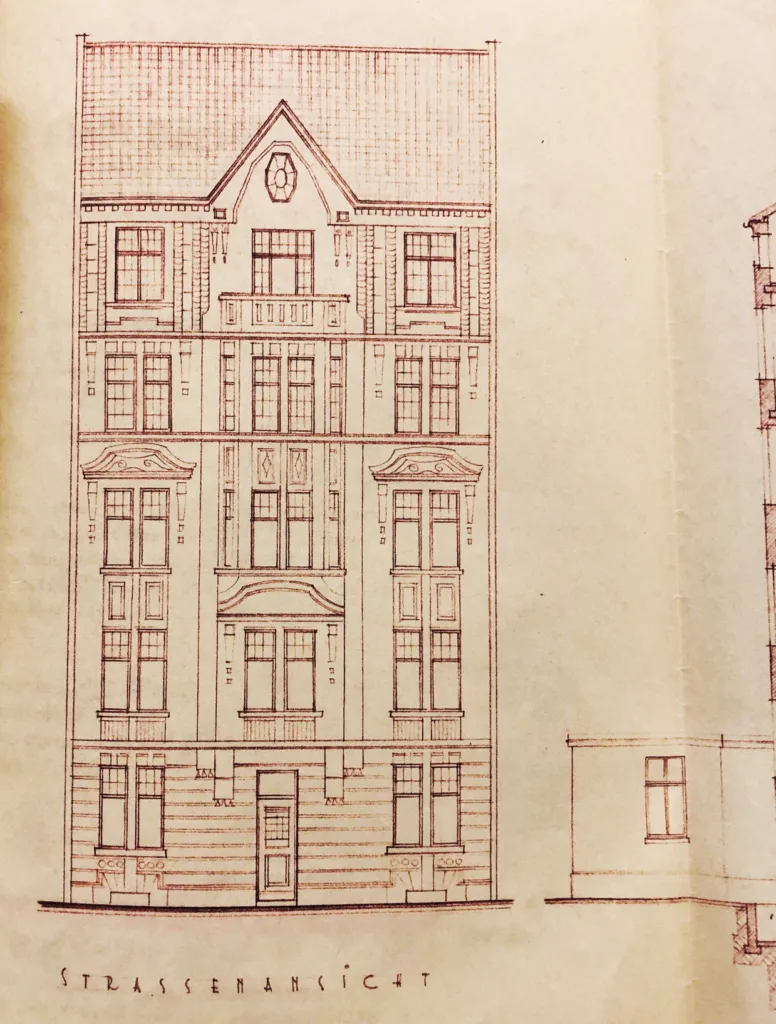
When this house was built around 1906, Dortmund’s Nordstadt was a building site in the best sense. The city was growing rapidly – and this building was part of it.
Just seven years earlier, Kaiser Wilhelm II had opened the Port of Dortmund – and with it Germany’s first major inland shipping canal, right on the doorstep. The quarter between the main station and the port was buzzing. The house at Gneisenaustraße 93 was built by wealthy citizens of this up-and-coming industrial city. They built it in the elegant Gründerzeit style, with a richly ornamented facade, high ceilings, wall ornaments and elaborate wood carvings, to the technical standards of the day.
On July 30, 1924, the Jewish Schnog family moved into Gneisenaustraße 93. After the November pogroms of 1938, Eugen Schnog was imprisoned in the Sachsenhausen concentration camp; in 1940 the family was forced to move, before they were deported to Auschwitz in 1943 and murdered. Today, three Stolpersteine in front of the house commemorate their fate.
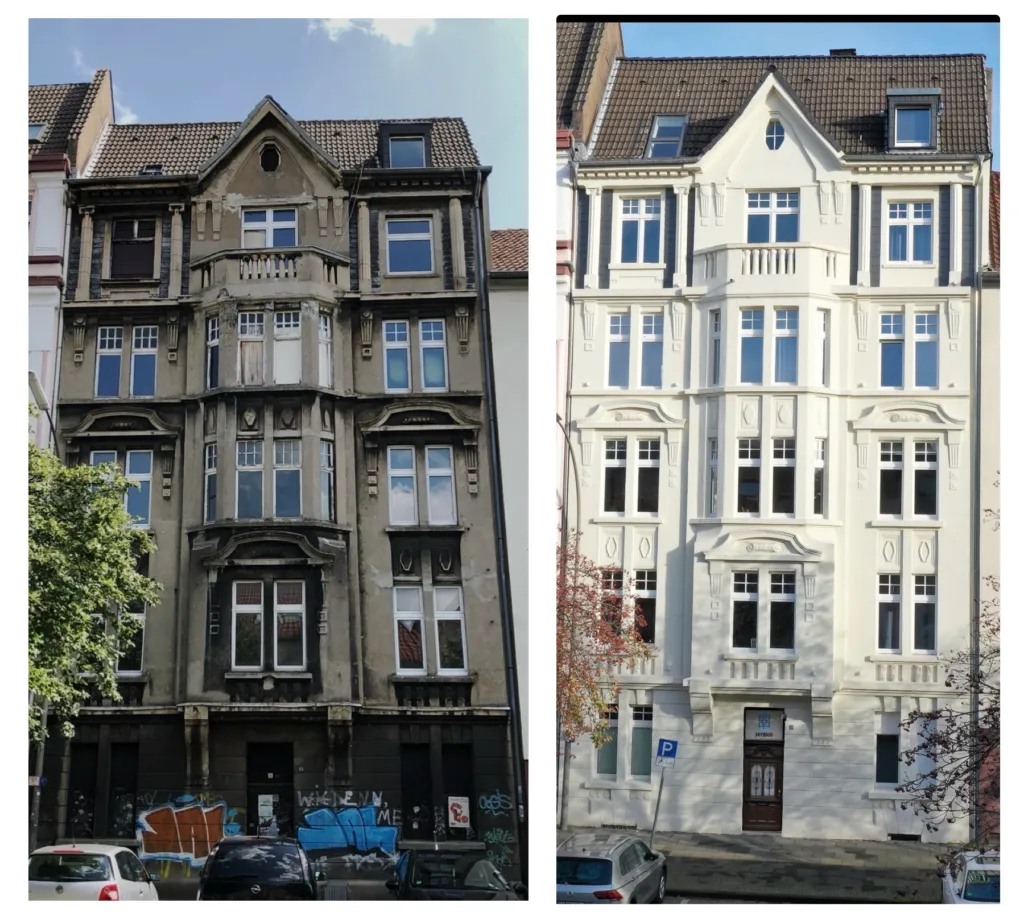
During the Second World War, Dortmund was almost completely destroyed – around 95% of the city center lay in ruins. A bomb hit the left half of the house and tore it down, while the right half and the entire facade miraculously remained standing. The neighboring houses had to be completely rebuilt after the war, but the original Gründerzeit facade of Gneisenaustraße 93 has survived for more than 120 years.
Dortmund’s north around 1906 – a city at its peak
When Gneisenaustraße 93 was built, Dortmund had just passed the 100,000-inhabitant mark. What that meant: big-city status, self-confidence, the will to build. In those years, the Nordstadt was the beating heart of the industrial city – densely built in perimeter blocks between 1890 and 1914. Today it is the largest contiguous Gründerzeit district in North Rhine-Westphalia.
The Port of Dortmund set off this boom. On August 11, 1899, Kaiser Wilhelm II ceremonially opened the port and with it the Dortmund–Ems Canal – 265 kilometers long, 15 locks, a link all the way to the North Sea. For the economy it was a breakthrough: Swedish iron ore could be shipped cheaply to the Ruhr, while coal and steel went the other way. The forecast capacity of 4.5 million tons of goods a year was exceeded just nine years after the opening. Today Dortmund is Europe’s largest canal port.
Workers and newcomers moved into the Nordstadt around the port. The three pillars of this city – coal, steel and beer – were rooted right in the neighborhood: the Hoesch steelworks, the Kaiserstuhl colliery, breweries. Alongside them were up-and-coming merchants, craftsmen and citizens who built apartment houses as investments at the time. Those who built solidly built for generations.
A Gründerzeit house like this was no ordinary building. Gründerzeit architecture stood for ambition: stucco facades with ornaments, cornices and pilasters, ceilings three to four meters high, large windows, imposing staircases. The construction – solid brick masonry with walls up to one meter thick in the basement – is the reason this house still stands today. The first upper floor, known as the bel étage, was the grandest floor and the most lavishly appointed. No factory workers lived in this house. People of means lived here.
The Schnog family – a life at Gneisenaustraße 93
On July 30, 1924, the Jewish Schnog family moved into the house. Eugen Schnog, born in Brackel in 1895, and his wife Johanna, née Marx, born in Schweinheim in 1895, had married in 1922. Here, at Gneisenaustraße 93, their daughter Edith was born on December 31, 1927.
Eugen Schnog was a merchant. The family belonged to the Jewish community of Dortmund, which was at its historical peak at the time – around 4,500 members, one of the largest Jewish communities in Westphalia. The synagogue on Hiltropwall, consecrated in 1900, had 1,300 seats and was one of the most magnificent in all of Germany.
After the pogrom night, everything changed. On December 31, 1938, Eugen Schnog was imprisoned in the Sachsenhausen concentration camp. On October 8, 1940, the family was forced to leave Gneisenaustraße 93 and move into a so-called “Judenhaus” (“Jews’ house”) at Papengarten 14 – one of many forced relocations the Nazis used to drive Jewish families out of their homes before deporting them. In 1943, Eugen, Johanna and Edith Schnog were deported to Auschwitz. All three were murdered. Edith was 15 years old.
Today, three Stolpersteine (“stumbling stones”) in front of the entrance commemorate their fate. The small brass plaques in the sidewalk – an art project by the Cologne artist Gunter Demnig – are today the largest decentralized memorial in the world: more than 120,000 stones in over 31 countries. Each one begins with the words “Hier wohnte” (“Here lived”). The full biography of the Schnog family is documented at juedisches-dortmund.de. Dortmund today has more than 400 such stones.
War damage and reconstruction
When Dortmund was almost completely destroyed by Allied bombing in the Second World War – by some estimates up to 95 percent of the city center was wiped out – Gneisenaustraße 93 was hit as well. A bomb struck the left half of the building and tore it down. The right half, with the original facade, survived. While the neighboring houses had to be rebuilt after 1945, this house still bears its original Gründerzeit facade today. The left half was rebuilt after the war and later kept in repair by a renovation in the 1970s – after that, the building was left to itself for a long time.
Chapter 2 · 2000–2020
The house stops breathing
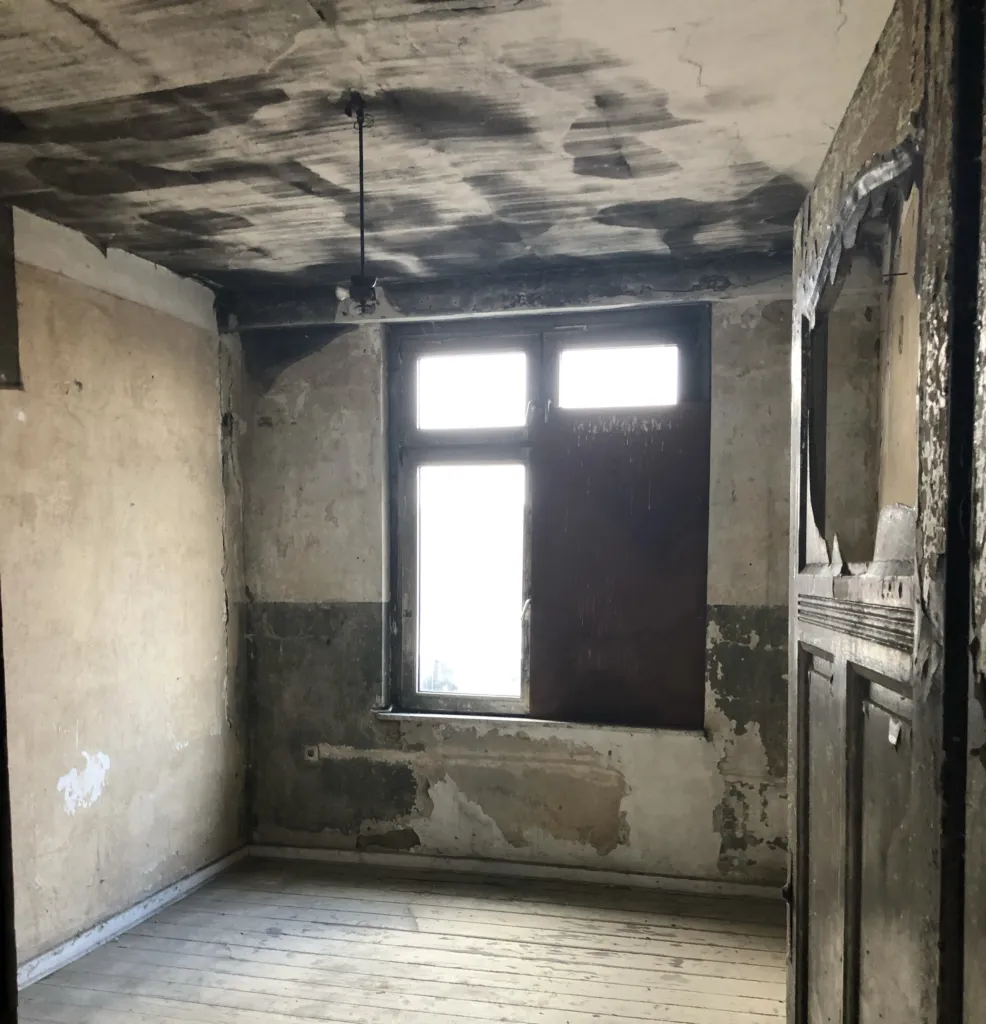
Sometime in the early 2000s, after a small fire, the last tenant moved out of the house. Then it fell silent.
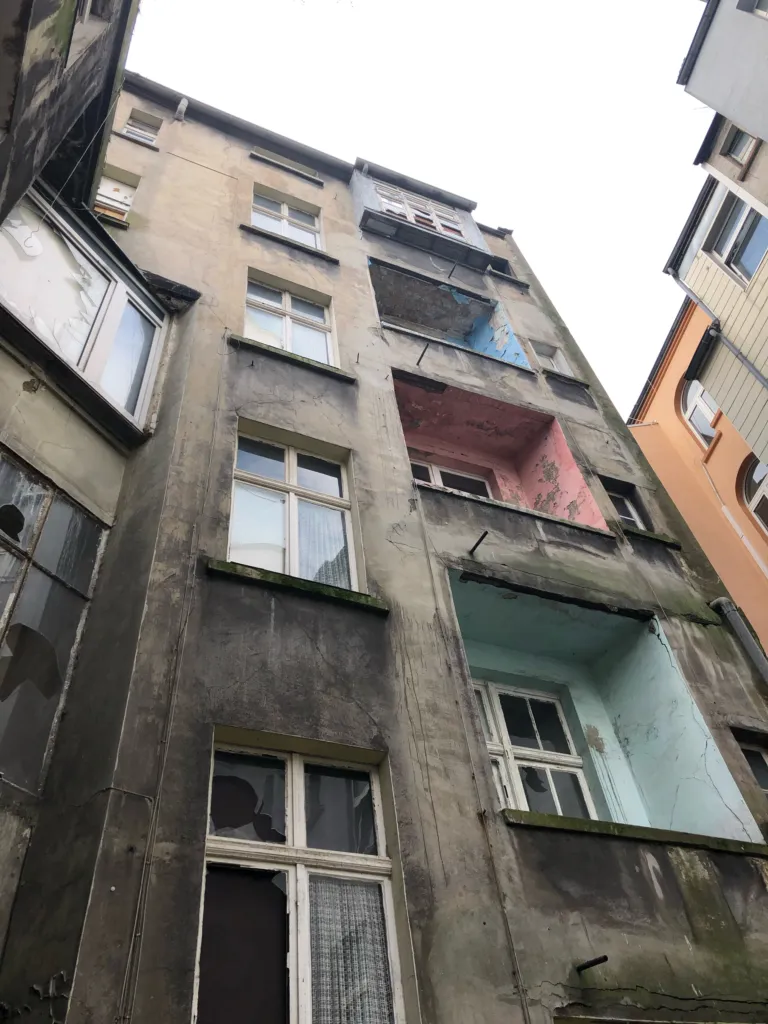
What followed were two decades of slow decay. Gneisenaustraße 93 became one of those buildings people would rather walk past. A facade at risk of collapse, bricked-up windows, traces of fire – the house became a problem property. It was not alone in this: at the time, the Nordstadt was struggling with a wave of neglected buildings that left a lasting mark on the neighborhood.
The owner at the time, who held the house until 2020, let the property fall further and further into disrepair over the years. Necessary safety and maintenance work was not carried out, warnings were ignored. The condition visibly worsened – and eventually became an issue beyond the neighborhood.
Time and again the property drew public attention. The city and the owner clashed repeatedly over responsibility, requirements and how the building should be handled. Gneisenaustraße 93 thus became not only a structural burden but also a local political issue.
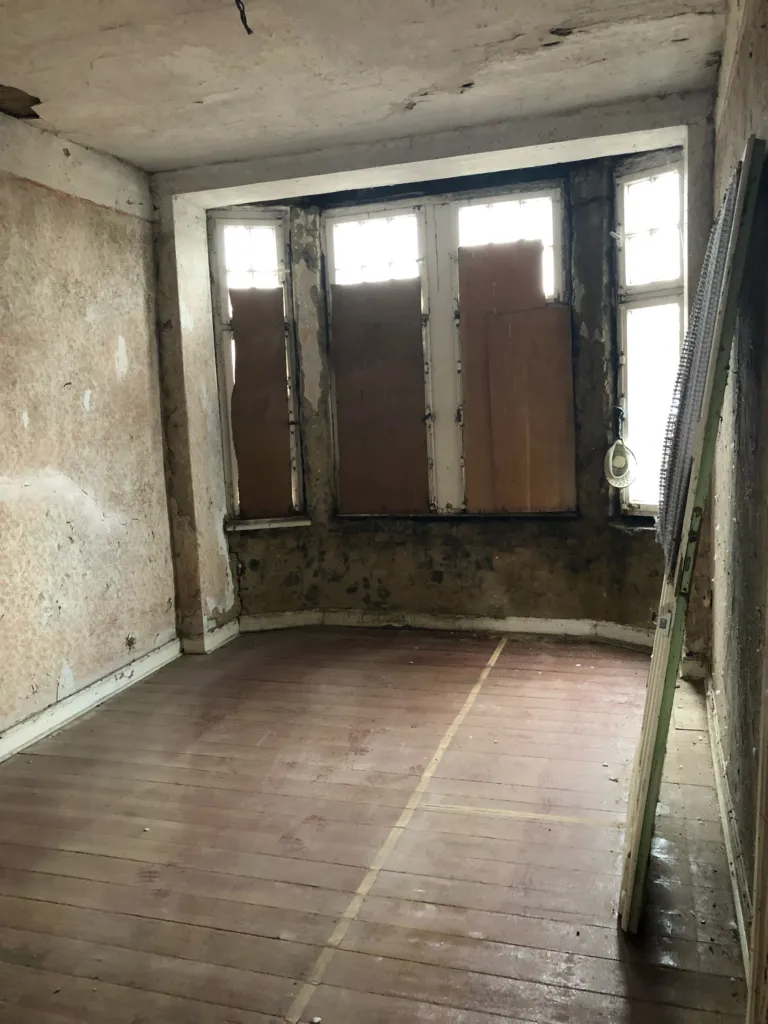
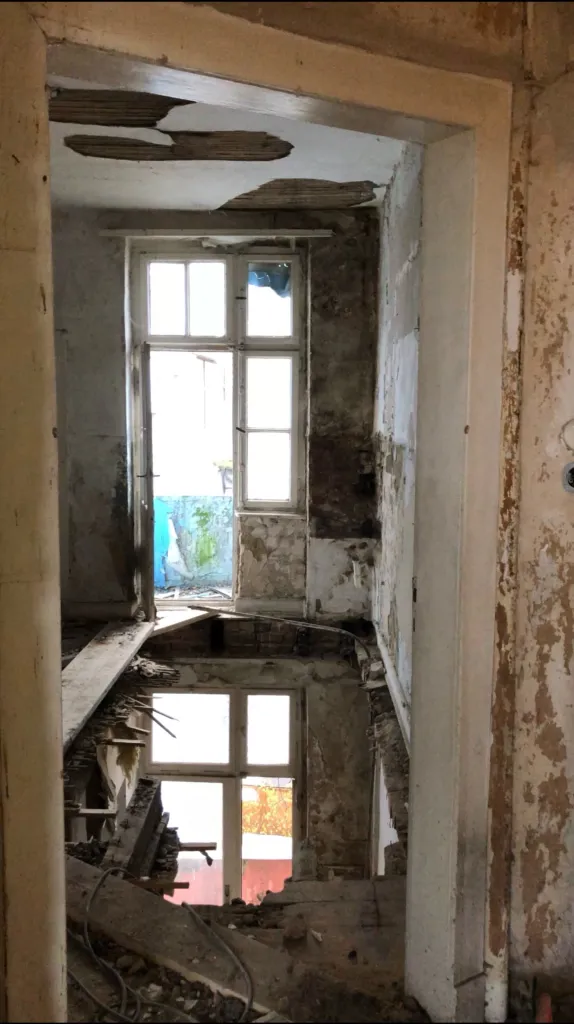
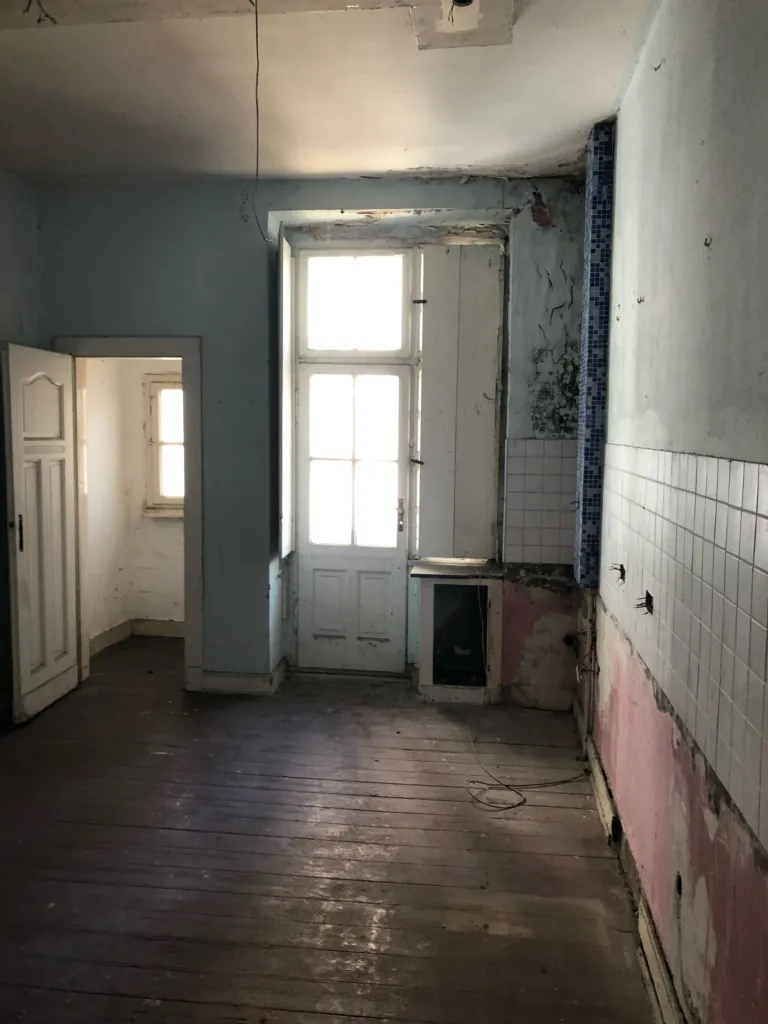
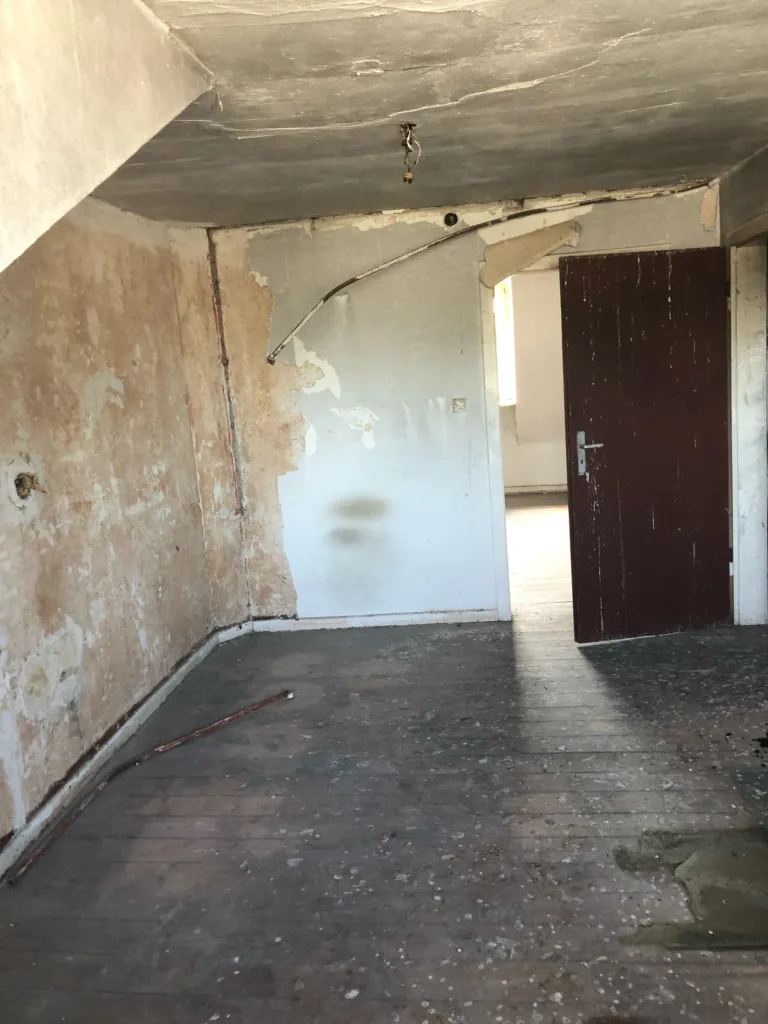
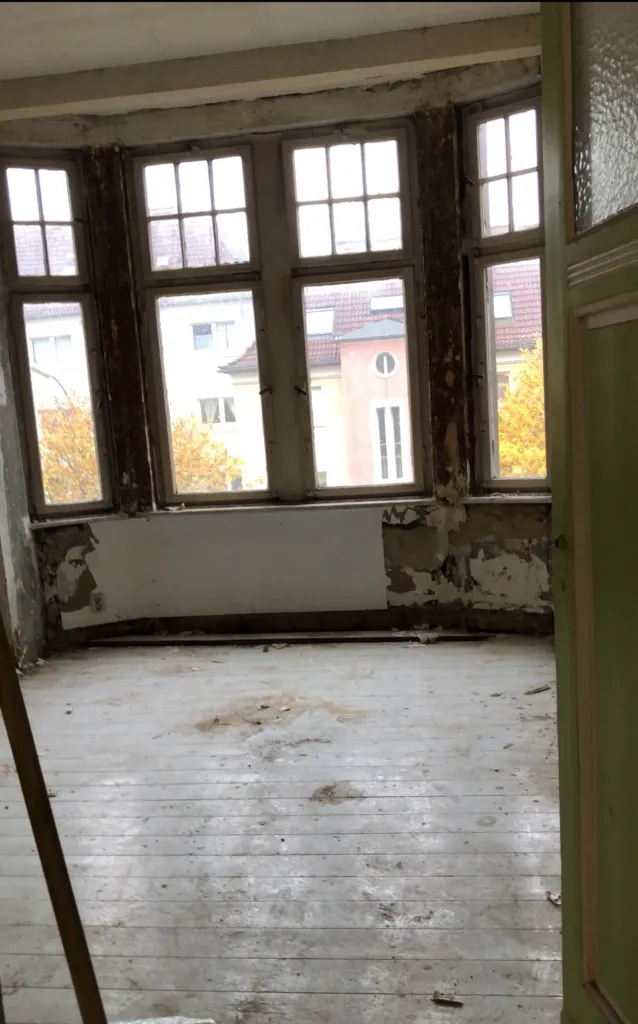
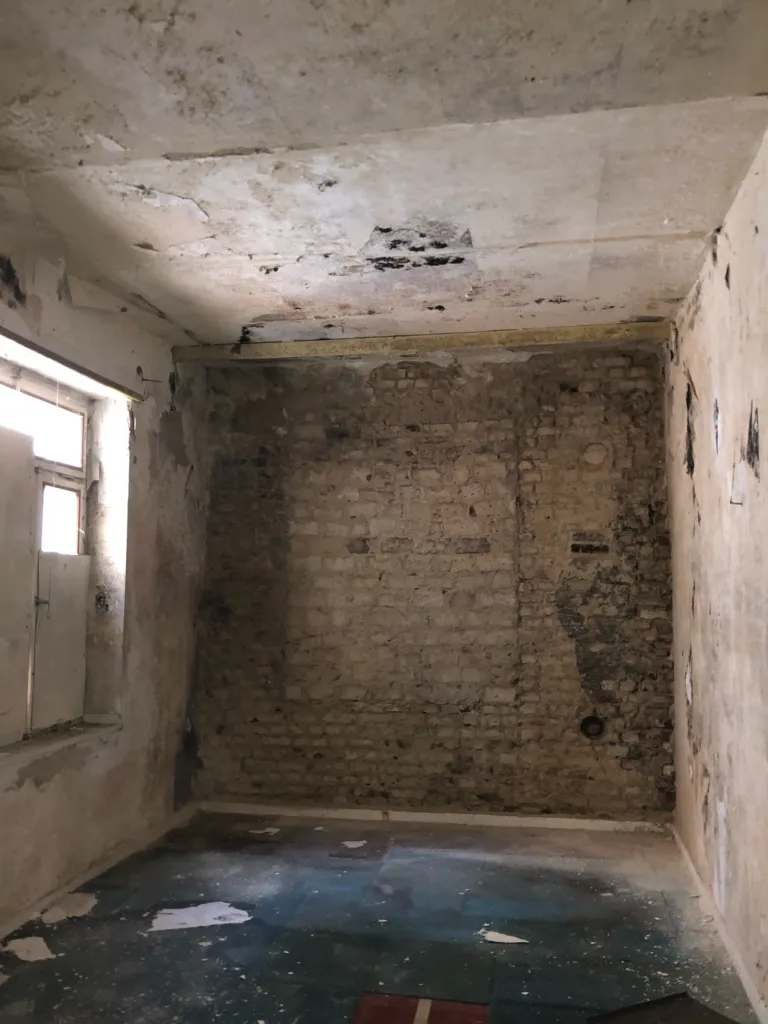
Until 2020 the house stood empty. Ceilings had collapsed, rooms lay open, wind and weather had free access. The rooms had long since found other occupants.
But the problem went far beyond this one house. In the early 2000s the entire region was at a low point. While the decay was reaching its peak in many places, the first visions were taking shape at the same time – and the first people willing to think big.
From around 2015, a slow change finally set in: the first renovations, new concepts and fresh ideas marked the beginning of a development that gathered more and more momentum over time.
In 2020 the house finally changed hands – and with that came a new perspective for Gneisenaustraße 93.
Vacant, forgotten, dilapidated
After the last tenant left, Gneisenaustraße 93 was left to itself. What happens to historic buildings when nothing is invested for decades is no secret – it happens fast. Moisture seeps into the walls, timber-beam ceilings begin to rot, plaster crumbles, glass breaks. Anyone walking past saw a facade that had once been beautiful. Inside, the house was no longer habitable.
The building slipped into the state that urban planners call a “problem property” – a term that sounds dry but says a lot. There were reports of a facade at risk of collapse. There was a fire. There were homeless people who sought shelter in the empty rooms again and again. And there was an unbelievable number of dead pigeons – the birds had taken over the house, the way animals take over empty buildings once people stop living in them.
The house was not the only one of its kind in the Nordstadt. Back then the Nordstadt was struggling with a serious structural problem: according to the City of Dortmund, in 2017 there were 122 problem properties in this district alone. Buildings that had become monuments to looking the other way. Owners who did not invest or could not. A district with a history – and a reputation it did not deserve.
Chapter 3 · 2020–Today
Return
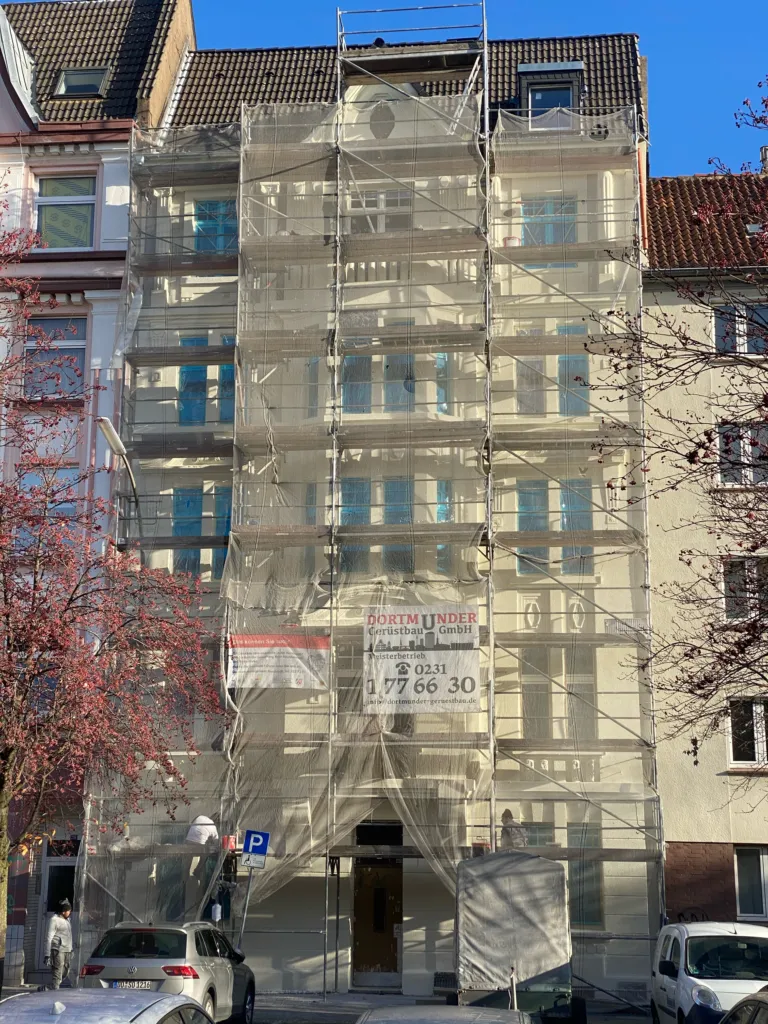
In 2020 the renovation began. What exactly that meant cannot be said in a single sentence.
Gneisenaustraße 93 is part of the City of Dortmund’s “Südliches Nordmarktquartier” redevelopment area – officially designated on January 31, 2025, but in practice actively supported for years. Today the city explicitly presents the house as a success story of this urban development work – with before-and-after photos that need no words.
The neighborhood around the house is not the same as it was ten years ago. And the next ten years will change even more.
The renovation – with the city, not against it
The renovation of Gneisenaustraße 93 was not a solo project. It was embedded in a citywide process that Dortmund has pursued consistently for years: the so-called “Dortmund Way” against problem properties. The principle: support and demand. First an inventory, then contact with the owner, then advice, then – if necessary – urban development orders. Those who renovate get support. Those who don’t get pressure.
The results of this policy are measurable: from 122 problem properties in 2017, the number fell to 39 by the end of 2022 – a drop of more than 70 percent. Gneisenaustraße 93 is one of these stories.
In February 2025 the City of Dortmund published two press releases that name the building as an example of successful urban renewal – with photos of its former condition and of the result today (in German):
- “Nordstadt in neuem Glanz: Stadt unterstützt Immobilien-Sanierung” (“The Nordstadt shines anew: city supports property renovation”, February 5, 2025)
- “Alles nur Fassade: Vom Schandfleck zum schmucken Wohnhaus” (“All just facade: from eyesore to handsome home”, February 4, 2025)
The renovation could also draw on tax incentives that apply to buildings in formally designated redevelopment areas: under Section 7h of the German Income Tax Act (EStG), modernization costs can be fully written off over twelve years – an instrument that makes private investment in existing buildings economically viable in the first place, and so keeps historic Gründerzeit buildings alive.
A neighborhood in transition – why this place is getting interesting right now
Gneisenaustraße 93 lies in the middle of one of the most exciting urban development processes in Germany. Right on the water, not far from the building, the Hafenquartier Speicherstraße is taking shape – one of the most significant urban transformation projects in the Ruhr. On 13.5 hectares at the Port of Dortmund, the city and private investors are putting around 296 million euros into the area by 2030. More than 4,100 new jobs are being created, along with 5 hectares of public space on the water, restaurants, culture and offices. The project won the EFRE.Stars NRW award (1st place) in 2023 and received an award at the German Urban Design Prize (Deutscher Städtebaupreis) in 2025.
Already open are the Academy for Theater and Digitality (September 2023, a pilot project unique worldwide as the 6th division of Theater Dortmund) and the Heimathafen Nordstadt (May 2024). For the northern area, the Dortmund University of Applied Sciences and Arts is looking into bringing all of its campus locations together – which would bring thousands of students into this neighborhood for good.
Other major projects are running in parallel: the redevelopment statute for the “Südliches Nordmarktquartier” – 75 hectares, around 1,100 buildings, in force since January 31, 2025 – secures the next 15 years of urban development right around the house. The urban development project Smart RHINO on the former Hoesch site is rethinking entire neighborhoods. And IGA 2027 – the International Garden Exhibition – is bringing extra attention to Dortmund’s north.
This house is not an isolated renovation project. It is part of a bigger picture that is just now becoming visible.
What has remained
The original entrance hall you are standing in dates from 1906. The facade is the same one that has outlived Kaiser Wilhelm’s opening of the port, the Second World War and twenty years of vacancy. The Stolpersteine in front of the door remember those who lived here and could not return. All of this is part of this place – not despite its history, but because of it.
We did not reinvent the house. We gave it back.
You can find out more about Jaybnb – who we are, what drives us and how we work – on our page about Jaybnb.